
At Claypool Primary School, we provide our children with a broad, balanced and inclusive curriculum, which enables them to make excellent academic, emotional and social progress. We base all of our learning on the ‘Model of Brilliance’, which was devised by all children, staff, governors and parents in school.
Our curriculum is predominantly based on the National Curriculum for England. This consists of three core subjects: English, Mathematics and Science, and nine foundation subjects: Beliefs and Values, Art and Design, Computing, Design and Technology (DT), Languages, History, Geography, Music and Physical Education (PE).
However, there are a number of additional aspects which we feel are important so that our children leave primary school as kind, confident, aspirational, respectful and resilient citizens who value diversity.
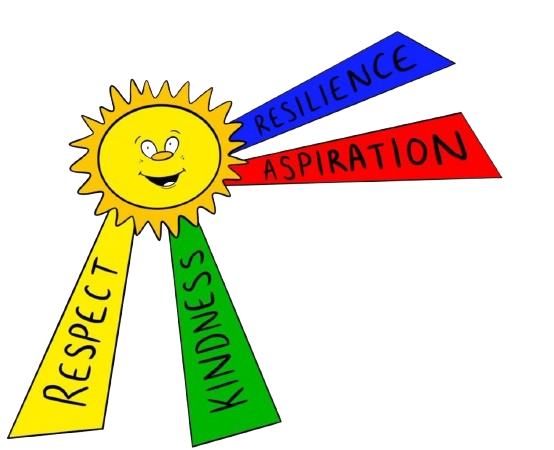
We implement our curriculum in line with our school ethos and our ‘rays of sunshine’ – aspiration, kindness, resilience and respect. Our aim is ensure that all of our children are excited about coming to school and are happy.
It is important that they are:
- aspirational about their own future and the future of others;
- kind at all times;
- resilient, confident to try new things and take risks;
- show respect and expect to be respected.
Particular care is taken to ensure that, from the earliest days, children are treated as individuals and that learning is carefully matched to their maturity and capabilities.
Parents and carers do have the right to withdrawn their child from Beliefs and Values lessons and some aspects of Sex and Relationship Education.
If you wish to find out more about our school curriculum, please contact your child’s class teacher or speak to a member of the Office Staff to make an appointment with a member of the Senior Leadership Team.
Learning Themes
Much of the curriculum at Claypool is delivered in an imaginative and stimulating way through learning themes which are based on a key question and a variety of fiction and non-fiction text types. The themes capture children’s enthusiasm and provide them with a firm base of knowledge, skills and positive attitudes to learning. Alongside the learning theme overview, children are provided with Knowledge Organisers which reinforce the learning taking place, its link to previous learning, key vocabulary and key influential figures. Children are encouraged to take ownership of their learning; therefore the learning challenges completed at home and the revision of the Knowledge Organiser, based on the learning theme, are an important aspect of their development. The themes are also enhanced by appropriate visits out of school and visitors coming into school.
Basic Skills
Teaching children basic skills in English and Mathematics is an integral part of the curriculum.
At Claypool, we believe that good oracy skills are key; if our children have the ability to express and articulate their own thoughts and ideas and are able to listen (and show they are listening) to others then they become good communicators. The children are given the opportunity to develop these skills in discussion, debate, conversation and speaking to an audience. The range of opportunities is large but includes: – the big debate, poetry mornings, class assemblies, nativities/carol concerts, showing around prospective parents, show and tell, oral retelling, paired and group learning, school council and pupil voice.
In Foundation and Year 1, phonics is taught through a systemic, synthetic scheme (Twinkl) on a daily basis as a whole class. This enables early readers and writers to revise, learn and apply their phonic knowledge.
The school has developed an effective reading scheme of work that operates from Foundation to Year 6. Children read a vast range of exciting and attractive fiction and non-fiction books during their time at Claypool; these are books that have been chosen carefully to meet their needs. Each class has a library and there is also a Research Laboratory for the whole school to access.
The school has developed an effective writing scheme of work which includes ‘Talk for Writing’, that enables staff to develop children’s writing skills methodically and systematically from Foundation to Year 6.
Our Mathematics curriculum aims, in line with national curriculum, are to ensure that all pupils:
- become fluent in the fundamentals of mathematics, including through varied and frequent practise with increasingly complex problems, so that the pupils develop conceptual understanding and the ability to recall and apply knowledge rapidly and accurately.
- reason mathematicallyby following a line of enquiry, predicting and testing relationships and generalisations; and developing an argument, justification or proof using mathematical language.
- can solve problemsby applying their mathematics to a variety of routine and non-routine problems with increasing sophistication, including breaking down problems into a series of simpler steps and persevering in seeking solutions.
The focus of our mathematics lessons will be the teaching of skills, methods and facts to enable pupils to solve problems. The children will be required to learn number facts with quick recall, so that when learning new methods they can concentrate on the process. The number facts they need e.g. times tables should not hinder their development. The children will be given time to practise skills so they become fluent in calculation methods and other mathematical skills e.g. using a protractor. However, our focus will be on enabling children to use these skills to solve problems, as we feel there are limited reasons for children knowing how to do something if they do not understand when it is appropriate to use it. The expectation will be that children can explain their mathematical thinking; maths lessons should not always be quiet lessons, but interactive and fun, with children engaged in tasks, sharing ideas and solving problems.
Children are strongly encouraged to access our web-based programmes – Century Tech, TT Rockstars, Rising Stars Online, Letter Join, Numbots and Purple Mash – in order to further develop their basic skills in school and at home.
Physical Education and Sports
We believe that Physical Education is critical to our children’s mental and physical well-being and impacts positively on their ability to learn effectively. Throughout our school we have adopted a ‘hands, head, heart’ approach to PE and the ‘School Games Values’ of passion, self-belief, respect, honesty, determination and teamwork.
In Foundation and Key Stage 1, the children are taught Physical Literacy Skills and in Key Stage 2 the skills and concepts required for a variety of sports are introduced, these sports include athletics, cricket, football, gymnastics, hockey, netball, rounders and rugby.
The children in Year 3 attend swimming lessons and will continue with these lessons until they are able to swim to the standards set by the National Curriculum.
All children in Key Stage 2 have access to adventurous activities at least once a year, this involves a level of risk taking and resilience which challenges the children year upon year. During their time in Year 6, children take part in a residential activities holiday and every 2 years there is an opportunity for the children in Years 5 and 6 to visit France for 5 days.
Sport is a particular strength of the school and we enter many competitions, the children are given many opportunities to use their skills and understanding. We teach the children to be dignified in victory whilst also recognising and celebrating their achievements.
Social and Emotional Education
The well-being of our children is central to our ethos and continually promoted throughout the curriculum. Outdoor learning is a key feature of our curriculum provision and regular opportunities are taken to use the outdoor learning environment to enhance the children’s experience in school.
The promotion of well-being gives our children brilliant opportunities to:
- be creative
- be active
- do something for someone else
- learning something new
- be curious
- work hard
These ‘Secrets of Wonderful Well-being’ help the children develop self-belief and high self-worth leading them to becoming aspirational, kind, resilient and respectful individuals and learners.
Our curriculum also emphasises the importance of pupil voice; spiritual, moral, social and cultural development and British Values. This includes learning relating to diversity, well-being, healthy relationships, the environment, the importance of good citizenship including digital citizenship and economic awareness.
Pupil Voice gives our children brilliant opportunities to:
- make a positive contribution to our school and the local community;
- take part in democratic activities across school;
- contribute to planning their own learning and expressing their views upon it;
- take part in age appropriate discussions and express their opinions on range of different topics and issues.
Spiritual development gives our children brilliant opportunities to:
- Explore beliefs, experiences and faiths, feelings and values;
- Enjoy learning about themselves, others and the surrounding world;
- Use imagination and creativity and reflect on experiences.
Moral development gives our children brilliant opportunities to:
- Recognise right and wrong and respect the law;
- Understand consequences;
- Investigate moral and ethical issues and offer reasoned views;
- Challenge injustice.
Social development gives our children brilliant opportunities to:
- Use a range of social skills to participate in the local community and beyond;
- Appreciate difference;
- Take responsibility, participate, volunteer and co-operate;
- Resolve conflict.
Cultural development gives our children brilliant opportunities to:
- Appreciate cultural influences;
- Participate in cultural opportunities;
- Understand, accept, respect and celebrate diversity.
The Promotion of British Values in the curriculum gives our children brilliant opportunities to understand:
- The rule of law;
- Promoting mutual respect;
- Democracy;
- Responsibility and liberty;
- Tolerance.